
Amazon Was Granted Patents to Track and Direct Workers’ Hands
Amazon received two patents for wristbands that could track and guide workers’ hands. Both later expired, and deployment remains unverified.
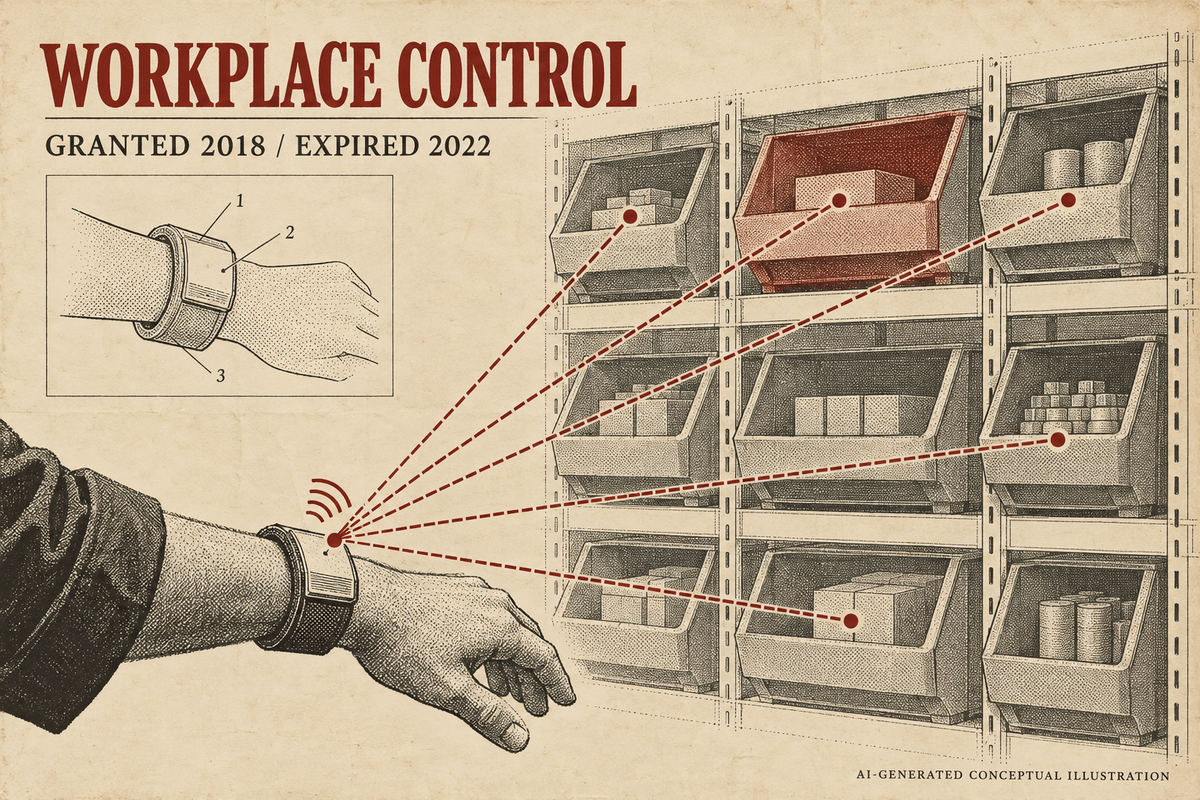
In 2018, Amazon Technologies received two U.S. patents for inventory systems that could locate a warehouse worker’s hand and vibrate to direct it toward the correct bin. The documents describe supervision that sits on the wrist and follows each reach.
STATUS: GRANTED, THEN EXPIRED; DEPLOYMENT UNVERIFIED. US9881276B2 and US9881277B2 were granted January 30, 2018. Their legal-event records list both patents as expired for failure to pay maintenance fees, effective January 30, 2022. Google Patents cautions that its status labels are not legal conclusions. OPD has not verified manufacture, deployment or use of either patented system on workers.
That distinction was present from the beginning. In a 2018 statement reported by GeekWire, Amazon described the idea as something that, “if implemented in the future,” could move equipment from handheld scanners to workers’ wrists. The statement framed the device as a way to free workers’ hands and eyes. It did not announce a rollout.
What the patents describe
The ultrasonic patent places pulse-emitting units near one or both hands. Receivers around inventory bins use those pulses to calculate where the wrist is. A management system compares that location with the assigned bin and can send haptic feedback indicating a correct or incorrect choice. The document also describes directional feedback and pulses carrying information such as a worker identifier, left or right hand, and duration of use.
The companion patent uses radio-frequency antennas. Its first claim describes continuously determining the wearable’s location in three-dimensional space and comparing that location with inventory bins. Other claims cover vibrations telling the user which direction to move a hand, a grip sensor and motions that let the worker enter a command or override.
The practical promise is fewer scans, button presses and picking errors. The same system also creates a detailed feed about how a person performs each assigned task. The patents repeatedly describe monitoring task performance. They do not require that data to remain limited to inventory accuracy.
When guidance becomes control
A vibration can be useful when it prevents a misplaced package. It can also make the worker’s body an endpoint of management software: reach here, correct this movement, continue. If the system records the time between actions, the distance traveled by each hand or repeated deviations from instructions, those records could support performance pressure far beyond a simple wrong-bin warning. That is a foreseeable use of the data, not documented evidence that Amazon used it that way.
The design also moves errors closer to the body. A bad bin map, missed signal or incorrect task assignment could produce a false correction. A worker would need a clear way to override the system without being treated as the source of the error. The RF patent describes an override gesture, but a technical command is not the same as a workplace rule protecting someone who challenges the machine.
These grants are expired and the specific systems remain unverified in use. The documents still show a concrete model of workplace control: measuring a worker’s hand continuously enough to instruct its next movement.
For another case in which radio signals turn movement into data, read Can Wi-Fi Really See You Through Walls?
Sources
Checked September 18, 2026: original US9881276B2 patent PDF; original US9881277B2 patent PDF; ultrasonic patent record; RF patent record; Amazon’s 2018 statement as reported by GeekWire. Hero artwork is an AI-generated conceptual illustration, not a patent drawing or deployed device.
Subscribe free for more source-checked case files. This article remains open to everyone.